BST-α
Crease Bending Stiffness Tester
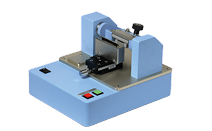
Measures crease bending stiffness of paperboard and corrugated board with high precision using motor-driven constant-speed rotation. Capable of evaluating material properties from initial gradient values, this is the standard instrument for crease inspection.
What Is Crease Bending Stiffness?
Crease bending stiffness is a quantitative measure of the force (torque) required to fold along the crease (score line) of paperboard or corrugated board. When this value is not properly controlled, it can lead to folding defects in the box-making process and poor opening performance of cartons.
Particularly for beverage and food cartons, crease bending stiffness directly affects automatic box-forming speed on filling lines, making stable management of this parameter a critical quality control item that impacts production efficiency and yield.
Measurement Principle — Motor-Driven Constant-Speed Torque Measurement
The BST-α fixes the test specimen and rotates it at a constant angular velocity using a motor drive, continuously measuring the torque applied to the crease. By eliminating variability from manual operation, it delivers highly reproducible measurement results.
Measurement data is acquired as a torque-angle curve, and in addition to the peak bending stiffness value, the initial gradient (slope of the curve's initial rise) can be calculated. Since the initial gradient reflects the elastic properties of the material itself, it is used as an indicator for early detection of material variations between base paper lots.
Differences from Manual Testers
With conventional manual instruments, the operator's speed and force inconsistencies affected measurement values. The BST-α's motor-driven system mechanically maintains constant speed, significantly reducing measurement variability for the same sample. It has been adopted as the standard instrument in quality control departments for many years.
Applications in Paperboard & Corrugated Industries
The BST-α is widely used in the following applications:
- Incoming paper inspection — Testing crease bending stiffness for each incoming lot to verify quality standards before process input
- Crease processing optimization — Quantitative evaluation of how changes in crease depth and profile affect bending stiffness
- Troubleshooting box-forming defects — Identifying root causes of folding defects from both crease quality and material perspectives
- Liquid carton openability evaluation — Used as an indicator for designing consumer-friendly packaging
Advantages of Motor-Driven Operation
The motor-driven system greatly contributes to standardization of measurement conditions. Since the test speed is constant, speed-dependent measurement errors can be eliminated when evaluating viscoelastic paper materials. Data comparison across multiple sites and operators becomes straightforward, supporting quality standard unification across the entire supply chain.
Acquired data can be managed and analyzed via PC connection using dedicated software, supporting advanced analysis such as torque curve overlay and lot-to-lot comparison.
Key Features
- Motor-driven — constant speed rotation for highly reproducible measurements
- Material property evaluation from initial gradient analysis
- Compatible with paperboard, corrugated board, and liquid cartons
- PC-connected data management and analysis
- Compact design
Specifications
Model | BST-α |
|---|---|
Method | Motor-driven torque measurement |
Target Materials | Paperboard, corrugated board, liquid cartons |
Parameters | Bending stiffness, initial gradient |
Output | PC connection (dedicated software included) |