AHT1000
Automatic Pellet Hardness Tester
Simultaneously automates the measurement of crush strength and particle size for granulated powders (0.2 to 2.0 mm). Simply load the sample to perform continuous measurement of up to 50 points. By combining video recording of the crushing process via a built-in CCD camera with a proprietary filtering function that invalidates errors, it enables highly reliable data analysis.
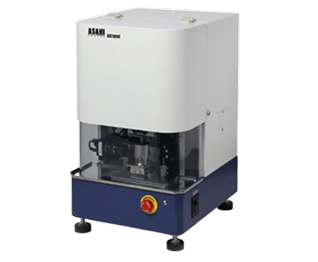
Measurement Principle — Simultaneous Measurement of Strength and Particle Size via Constant-Speed Loading Method
The AHT1000 is a device that measures the individual crush strength (hardness) of granulated powders using a constant-speed loading method. It applies a load to the sample at a constant speed and detects the load decrease (crush point) the moment the particle is crushed (fractured). The greatest feature of this device is its ability to simultaneously measure and record the strength (load) at the time of crushing and the "particle size." This enables a more multifaceted analysis of the dispersion within a particle population, rather than just evaluating the average hardness.
Automatic Continuous Measurement via Sample Cup Loading
In conventional individual particle hardness measurement, particles had to be manually set onto the stage one by one using tweezers, requiring significant time and effort. With the AHT1000, simply loading the sample into the sample cup and setting it into the device enables automatic continuous measurement of a specified number of points (up to 50 points). The adoption of a simple mechanism significantly reduces the processing time per measurement from sampling to cleaning, dramatically reducing the operator's burden. It supports a wide measuring particle size range of 0.2 to 2.0 mm (200 to 2000 µm), automatically processing various samples.
Video Recording of the Crushing Process (Equipped with CCD Camera)
The AHT1000 is equipped with a CCD camera, which records the process from pressurized compression to crushing as a video. By reviewing the images after measurement, you can visually grasp what kind of fracture mode caused the particle to crush. Comparing the load-displacement curve with the video makes it easier to identify the causes of abnormal values and compare fracture behaviors, providing useful information for optimizing particle design and granulation conditions.
Highly Reliable Data Extraction and Safety
- Proprietary Filtering Function: Multiple filtering functions invalidate sampling error data, extracting and analyzing only highly reliable data.
- Comprehensive Safety and Maintenance Design: Equipped with a shutter cover that automatically closes during operation, an emergency stop switch, and an overload error function. In addition, it boasts high maintainability, coming with a dedicated cup to receive the sample after measurement and a tray for cleaning scattered powder.
Comparison with Manual Measurement
The introduction of the AHT1000 completely solves the challenges faced by conventional manual measurement.
Item | Conventional Manual Measurement | AHT1000 |
|---|---|---|
Particle Supply | Manual work using tweezers | Automatic supply via sample cup |
Measurement Time | Significant time and effort | Dramatically reduced (Automatic continuous measurement of up to 50 points) |
Variations Between Operators | Large (depends on setting position) | Nearly zero |
Image Recording | Separate shooting required | Video recording of the process via CCD camera |
Data Output | Manual entry | Automatic aggregation and distribution mapping via dedicated app (CSV output available) |
Specifications
Model | AHT1000 |
|---|---|
Measuring Particle Size Range | 0.2 to 2.0 (mm) |
Measurement method | Constant-speed loading method |
Descent Speed | Selectable from 0.1, 0.2, 0.4, or 0.5 mm/sec |
Load Cell | 0.5N, 10N, 20N, 30N (*Specifications can be changed upon ordering) |
Data Output | Aggregation via dedicated application, CSV format output of load-displacement curves |
Dimensions / Weight | W300 × D350 × H515 (mm) / Approx. 25kg |