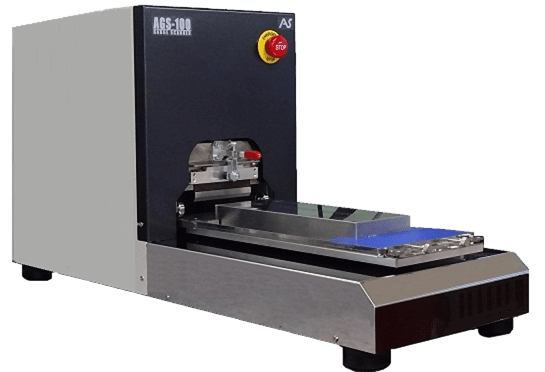
AGS-100
Automatic Grind Gauge System
A scanner device that realizes automatic squeegeeing and high-resolution image capture of grind gauges. It supports a wide range of gauge sizes using dedicated attachments. By eliminating manual measurement errors and applying various filter functions, it enables the data extraction of fine particles and lines (scratches) that are normally difficult to judge with the naked eye.
What Is Grind Gauge Measurement?
A grind gauge (fineness of grind gauge) is a standard testing instrument used to evaluate the size of particles and agglomerates contained in liquid materials such as inks, paints, and coatings. The sample is poured into the groove on the gauge surface, and the degree of dispersion is read from the lines or dots of particles that appear when drawn with a squeegee. This test method is widely used in the paint and ink industry—from raw material receiving inspections to pre-shipment inspections—and is indispensable for quality control in the dispersion process.
Objective Evaluation through Automatic Squeegeeing (AGS-100 Principle)
The AGS-100 is a scanner device that automates the "squeegeeing" process of grind gauges used for dispersion evaluation of various samples. In conventional visual and manual methods, subtle differences in squeegee speed, angle, and pressing pressure affect the measurement results. By automating the squeegee process with a mechanical constant-speed, low-load method, the AGS-100 eliminates variations in test results caused by operators, enabling the stable and repeatable acquisition of identical measurement data.
Unique Image Processing and Judgment Assist
- Simultaneous Squeegee Image Processing Mode — A mode that performs image processing immediately while squeegeeing the sample. It is highly effective for measuring fast-drying samples, such as solvent-based inks, or samples whose liquid surface changes easily.
- Dedicated Light Source Switching — By switching the dedicated light source that illuminates the gauge between "vertical illumination" and "oblique illumination" depending on the sample, data reproducibility is greatly enhanced.
- Filter Functions — By applying various correction processes (filters) to the acquired high-resolution images, fine particles and lines (scratches) that are normally difficult to judge can be clearly reproduced and digitized.
Key Features
- Stable measurement data: Mechanical automatic squeegee function utilizing a constant-speed, low-load method.
- Dedicated attachment support: Broadly compatible with various sizes of grind gauges from different manufacturers.
- Versatile filter functions: Assists in judging particles and lines that are difficult to confirm visually.
- Equipped with dedicated light sources: Improves reproducibility by switching between vertical and oblique illumination.
- Data management: Measurement results are saved as high-resolution images and can be reviewed at any time.
- Safety design: Equipped with a front emergency stop switch and a safety cover operation lock function (interlock).
Specifications
Model | AGS-100 |
|---|---|
Operation Method | Constant-speed, low-load method |
Squeegee Speed | 10, 15, 20, 25 mm/s |
Supported Gauge Sizes | 10, 25, 50, 100, 200 µm |
Squeegee Pressure | Adjustable by knurling |
Communication Port | USB 3.0 × 2 |
Dimensions / Weight | W250 mm × H390 mm × D710 mm / 23 kg |
Power Supply | AC100–240V, 50/60Hz, 100W |